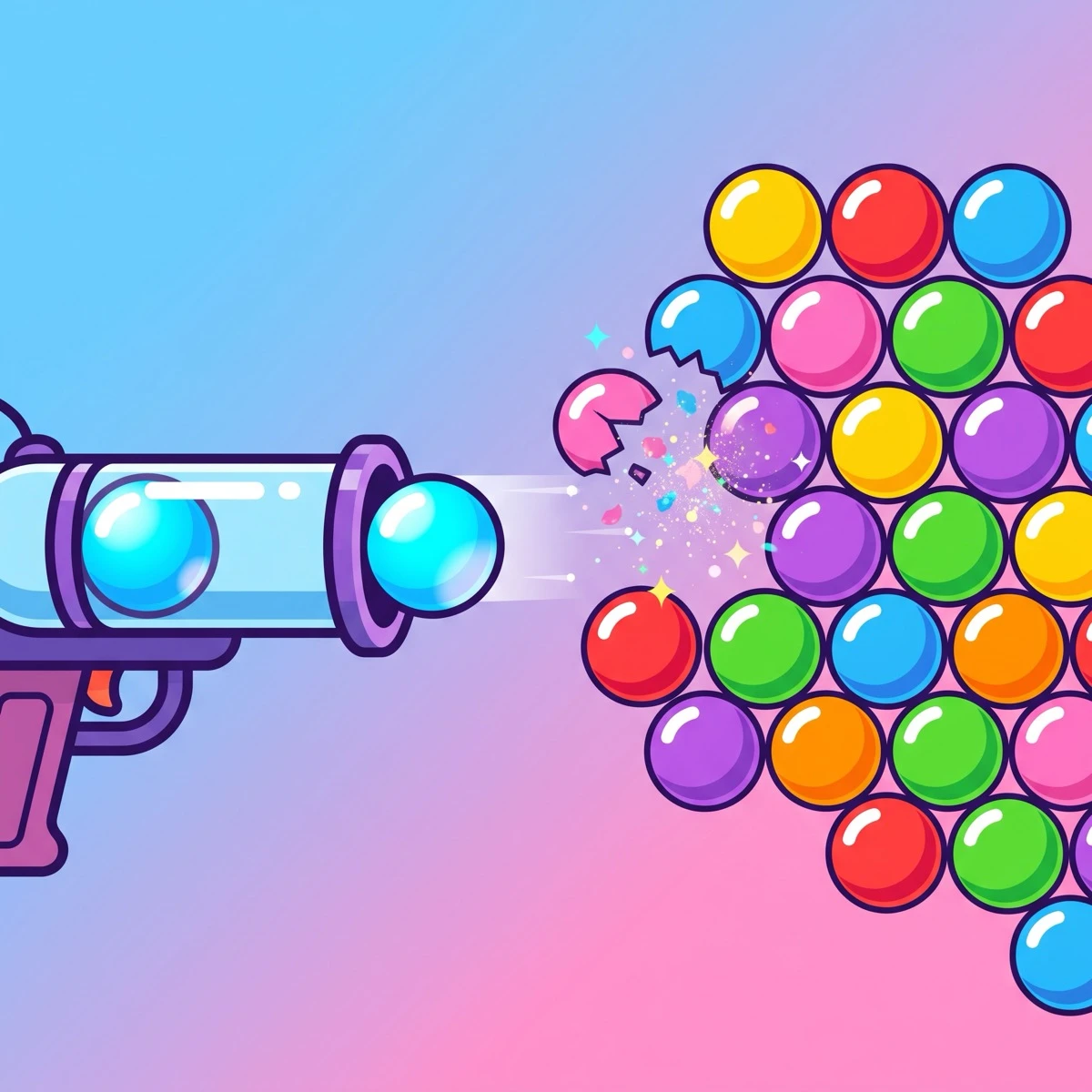
But there's more going on under the surface than most casual players realize. Once you understand the mechanics — how clusters fall, why bounce shots matter, how the board tightens over time — your scores go up quickly. And you start noticing which games are genuinely well built and which ones just look the part.
This guide covers the fundamentals: what a bubble shooter actually is, the rules every version runs on, how the variations differ, and how to spot one that won't nag you for a signup. No prior experience needed.
What a Bubble Shooter Game Actually Is
A bubble shooter is a puzzle game where you launch colored bubbles at a cluster of other colored bubbles. Match three or more of the same color, and that group pops and disappears. Clear the board, or survive as long as possible, depending on the version.
The launcher usually sits at the bottom center of the screen. You control the angle, not the power. That single constraint — angle only — is what turns a simple matching game into a geometry puzzle.
The genre traces back to arcade and console puzzle games from the 1990s, most famously the Puzzle Bobble series (released in North America as Bust-a-Move). Those games established the template: a bottom-mounted cannon, a ceiling of bubbles slowly descending, and walls you can ricochet off. Nearly every bubble shooter since has borrowed from that blueprint.
The Core Rules Every Version Shares
Different games dress this up differently, but the underlying mechanics are remarkably consistent. Learn these five and you can pick up any bubble shooter cold.
- The three-match rule. A bubble pops only when it joins two or more bubbles of the same color, creating a group of three or more. Two matching bubbles sitting together do nothing until you add a third.
- Detached clusters fall. This is the big one beginners miss. Bubbles hang from the ceiling or from other bubbles. If you pop a group and that leaves bubbles with no connection to the top, they drop off the board — often scoring more than the pop itself.
- The board advances. In most versions, the wall of bubbles moves down periodically, either after a set number of shots or on a timer. If it reaches the bottom line, the round ends.
- Walls are usable, ceilings usually aren't. You can bank shots off the left and right edges to reach spots you can't hit directly. The top is typically occupied by bubbles, so there's nothing to bounce off up there.
- You know what's coming next. Almost every bubble shooter shows you the current bubble and the next one. Ignoring that preview is the single most common beginner error.
That's the whole rulebook. Everything else is presentation.
The Main Variations You'll Encounter
Understanding these categories helps you pick something that matches how you like to play. Two games can share identical mechanics and feel completely different.
Classic Endless Mode
The purest form. One continuous board, no levels, no story. The bubbles descend as you shoot, and you play until the board reaches the bottom. Your score is the reward.
A plain browser version like Bubble Shooter is a good reference point for this style — a single-screen layout with straightforward aiming and no clutter between you and the board. If you want to learn the fundamentals without tutorials or timers interrupting you, endless mode is where to start.
Level-based Progression
Here the game gives you a fixed board, a limited number of shots, and an objective — clear all bubbles, rescue something at the bottom, reach a score threshold. Complete it, move to the next level.
This structure adds puzzle-solving on top of aiming skill. Some boards have a genuinely correct solution, and figuring it out is the point. Bubble Shooter 3 leans into this approach with a level structure that gradually introduces tighter layouts and trickier angles rather than dropping you into difficulty immediately.
Timed and Arcade Modes
Instead of a shot counter driving the descent, a clock does. The board keeps creeping down whether you shoot or not, so these reward fast pattern recognition over careful planning. They're a poor place to learn — you'll be firing at the nearest match instead of the useful one — but excellent practice once the geometry is second nature.
Falling Vs. Anchored Boards
Most bubble shooters anchor bubbles to the ceiling. A smaller category flips it — bubbles obey gravity and stack from the bottom, and you're shooting upward into a pile. The three-match rule still applies, but cluster-drop logic works in reverse. Worth trying, but learn the standard version first.
Physics-based and Hybrid Designs
Some newer titles add momentum, bouncing bubbles, or destructible obstacles. These are fun, though the added variables make outcomes less predictable. Purists tend to prefer the tighter, more deterministic classic style.
What Separates a Good Bubble Shooter from a Mediocre One
This is where a little knowledge saves a lot of frustration. I've worked through a lot of these in the dead hours between matches at club tournaments, and the quality gap is wider than the screenshots suggest. Here's what actually matters.
A Visible, Accurate Aim Guide
The best games show a dotted or solid line projecting from your launcher, including where the shot will bounce off a wall. Some show only a short stub, forcing you to estimate.
Neither is wrong — full aim lines are friendlier for beginners, short lines are more skill-testing. What matters is consistency: the bubble must land exactly where the line predicts, every time. A guide that lies to you makes a game unplayable.
Honest Color Distribution
The bubble you receive next should be drawn fairly, and ideally only from colors still present on the board. Poorly designed games hand you colors that no longer exist anywhere, wasting shots through no fault of your own.
A well-built shooter stops generating a color once it's been fully cleared. That one design detail separates thoughtful games from lazy ones.
Precise Controls
On a mouse, the pointer position should map directly to the angle. On touchscreens, the better implementations let you drag anywhere on the screen to fine-tune the angle, rather than requiring you to tap the exact target — your finger blocks the view otherwise.
Restraint with Interruptions
Free games need revenue, and that's fine. The question is whether interruptions land between rounds or in the middle of them. Games that pause mid-board, or that gate progress behind waiting periods, break the flow that makes the genre relaxing in the first place.
Browser-based versions often sidestep this entirely. Arkadium's Bubble Shooter is a widely syndicated example — it runs in the browser with nothing to install, which is the format you'll usually find sitting on newspaper puzzle pages.
Offline Availability
If you play on a phone during commutes or in waiting rooms, check whether the game works without a connection. Many don't, and finding out at the wrong moment is annoying.
Accessibility Considerations
Bubble shooters are frequently recommended as accessible games because they need only one input and no reaction speed in classic mode. Look for:
- Colorblind support — shapes, patterns, or symbols inside bubbles rather than color alone
- Adjustable or disabled timers so you can think as long as you want
- Scalable interface elements for smaller screens or low vision
- Sound-optional design where audio adds atmosphere but never carries required information
Roughly one in twelve men has some form of red-green color vision deficiency — the figure most eye-health references land on — so pattern-marked bubbles aren't a niche feature. They're a meaningful quality signal.
Strategy Fundamentals That Work in Every Version
Here's the practical part. These principles apply whether you're playing a browser classic or a level-based mobile title.
- Shoot high, not low. New players fire at whatever's closest. Experienced players aim at the top of the cluster, because popping bubbles up there detaches everything hanging below. A single well-placed shot can clear a third of the board.
- Look for support columns. Scan for narrow stems where a wide section hangs from just a few bubbles. Break the stem, and the whole section falls without you touching it.
- Use the walls deliberately. Bank shots reach pockets and overhangs that direct fire can't. Practice this on easy boards until the reflection angle feels natural — it's just mirror geometry, and your intuition builds faster than you'd expect.
- Plan two shots, not one. The preview exists for a reason. If your current bubble is blue and the next is red, place the blue somewhere that sets up a red match, rather than dumping it in the nearest gap.
- Park spare bubbles at the edges. When you're handed a color you can't use, tuck it against a side wall rather than the center. Center placements build a growing lump that blocks your access to the top of the board.
- Watch for dying colors. When a color is down to its last two bubbles, clearing them removes that color from the pool entirely, which makes every future bubble more useful. That's a real strategic goal, not just cleanup.
- Keep vertical space. Every shot that doesn't pop something adds to the board and brings the descent closer. Shots that clear more than they add are the only sustainable way to play a long endless run.
Common Beginner Mistakes
- Firing without looking at the next bubble. Costs you a usable match roughly every few shots.
- Ignoring bounce shots. Half the board becomes unreachable if you only shoot in straight lines.
- Popping the easiest group instead of the most valuable one. Three bubbles at the bottom versus three at the top that drop fifteen more — not a close call.
- Building a center tower. Misplaced bubbles in the middle stack up and wall off your best targets.
- Rushing in untimed modes. Classic bubble shooters have no clock. Take the extra seconds and study the board.
How to Pick Your First Game and Build Skill
A reasonable progression looks like this:
- Start with a browser-based classic. No download, no account, no progression system — just the core mechanic. This is where you learn the three-match rule and cluster physics.
- Practice bounce shots on purpose. Spend a few rounds deliberately using only wall shots, even when direct ones are available. Awkward at first, then automatic.
- Move to a level-based game. Fixed shot counts force you to think about efficiency rather than volume.
- Try a timed mode. With the geometry already internalized, speed becomes the only remaining variable.
- Explore variants. Gravity-based boards, physics hybrids, obstacle mechanics — all much easier once the fundamentals are solid.
You don't need to spend money to get a complete experience. The genre has been free-to-play on the web for decades, and many browser versions are as polished as paid apps.
Why the Genre Has Lasted
Bubble shooters survive because the design is close to ideal for casual play. One input. No reading. No reflexes required in classic mode. Sessions that fit into two minutes or two hours equally well. A rule set you can learn in fifteen seconds and keep improving at for years.
That combination is rare. It's also why the genre keeps appearing on newspaper puzzle pages, accessible-gaming lists, and app store charts, generation after generation of hardware.
Learn the five core rules, get comfortable banking off the walls, aim high instead of near, and actually look at the next bubble. That's most of the skill ceiling — and it transfers to every version you'll ever play.