This guide walks through the main families of number puzzles, what makes each one tick, and how to actually get better at them. No prior math skill required. If you can count to nine and follow a rule, you can play almost everything here.


Game Guides
A Beginner's Guide to the Best Number Puzzle Games

Number puzzles have a reputation problem. Plenty of people hear "number game" and immediately think back to a math class that didn't go well. The good news is that most of the best number puzzle games barely involve arithmetic at all. They use digits the way a crossword uses letters — as symbols you arrange according to rules.
Play these right now
Every game here runs free in your browser — no download, no account.
-
Sudoku
3.8"Sudoku" is a classic and addictive numbers puzzle game that challenges your logical thinking and problem-solving skills.
-
Numberle
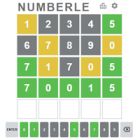
3.9Numberle is a captivating online number puzzle game inspired by Wordle, offering players a fresh and intellectually stimulating experience.
-
-
-
Mastermind
3.6Mastermind Online is a classic and challenging code-breaking game designed for solo play.


What Counts as a Number Puzzle Game?
A number puzzle is any game where digits are the primary pieces you manipulate. That's a broad tent, so it helps to split it into three groups based on what the numbers are doing.
- Numbers as labels. In Sudoku, you could swap all the digits for nine different colors and the puzzle would work identically. The digits are just distinguishable tokens. These are pure logic puzzles.
- Numbers as values. In Kakuro or an equation-guessing game, the actual quantity matters because you're adding, multiplying, or comparing. These are arithmetic puzzles.
- Numbers as objects in space. In sliding-tile and merging games, you're moving numbered pieces around a board. Position matters as much as value. These are spatial puzzles with a numeric skin.
Knowing which group a game belongs to tells you what skill it's actually training — and whether you'll enjoy it.
Family One: Grid Logic Puzzles
This is the largest and most popular category, and it's where I'd point most beginners. It's where I started, and easy Sudoku is still what I reach for on a night when I want to think without doing arithmetic.
Sudoku
The classic. A 9×9 grid split into nine 3×3 boxes. Fill every cell with a digit from 1 to 9 so that no digit repeats in any row, column, or box. That's the whole rulebook.
Sudoku is the reference point for the entire genre because the rules fit in one sentence but the deduction chains can run deep. A well-made Sudoku always has exactly one solution reachable by logic alone — you should never have to guess.
Killer Sudoku
Standard Sudoku rules, plus the grid is divided into outlined "cages," each with a target sum. The digits inside a cage must add to that total without repeating. This version does require light addition, but the sums are small and the logic still does the heavy lifting.
Kakuro
Think of a crossword where the answers are digits. Each horizontal or vertical run has a clue number that the run must sum to, using digits 1–9 with no repeats inside a run. A run of two cells summing to 17 has exactly one possibility: 8 and 9. That kind of forced answer is your entry point into every Kakuro.
Futoshiki and Comparison Grids
Smaller grids (often 5×5) where the constraints are inequality signs between cells rather than sums. You know one cell is greater than its neighbor, and you work outward from there. These make excellent five-minute puzzles.
Nonograms (Picture Logic)
The clue numbers describe runs of filled squares in each row and column, and solving the grid reveals a small picture. Technically the numbers are just instructions, but the deduction feels closely related to Sudoku, and fans of one usually enjoy the other.
Family Two: Arithmetic and Equation Puzzles
Here the math is real, but it stays at the elementary level. What's being tested is flexibility with numbers, not computational speed.
Kenken and Calculation Cages
A Latin-square grid (each digit once per row and column) divided into cages, each labeled with a target and an operation: 12×, 3−, 24+, and so on. You figure out which digit combinations can produce the target, then use the row and column rules to narrow it down.
Crossmath and Equation Grids
You're given a grid of arithmetic expressions with blanks, and a pool of digits to place. Every horizontal and vertical equation must come out true simultaneously. These teach you to think about operator precedence — that multiplication resolves before addition — without ever using that phrase.
The 24 Game and Target-number Puzzles
Given four numbers, use each exactly once with any operations to reach a target. It's less about deduction and more about creative recombination. Good for short bursts and genuinely good practice for mental arithmetic.
Equation Guessing Games
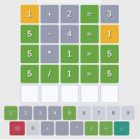
A newer format borrows the structure of daily word games and applies it to math. In Mathle, you're trying to identify a hidden equation. Each guess must be a valid equation itself, and the game tells you which digits and symbols are in the right place, which are present but misplaced, and which don't appear at all.
That feedback loop is what makes the format work. You're not calculating — you're running an investigation, using each guess to eliminate possibilities.
Family Three: Deduction and Guessing Games
These deserve their own section because the skill involved is different: information gathering.
Bulls and Cows / Mastermind
One of the oldest number games around. Your opponent picks a secret four-digit number; you guess, and they tell you how many digits are correct and correctly placed versus correct but misplaced. Repeat until you've cornered the answer.
The modern digital version of this idea is Numberle, where you deduce a hidden number using color-coded feedback on each attempt. The strategy is worth understanding because it applies far beyond this one game:
- Open wide. Your first guess should cover as many distinct digits as possible. You learn more from testing five new digits than from a clever guess reusing digits you've already ruled out.
- Separate confirmation from exploration. Early guesses gather information. Later guesses lock in placement.
- Track what's excluded, not just what's included. Beginners focus on the greens. Experienced players get more mileage out of knowing which digits are definitely absent.
- Respect the positional clues. A "correct digit, wrong spot" result eliminates one position permanently. Don't put it back there.
If you enjoy that feedback structure, it's worth knowing that the same mechanic drives word versions too. Dordle runs two puzzles side by side at once, which forces you to think about how a single guess pays off across two separate problems — a useful mental stretch even if you normally prefer digits to letters.
Family Four: Merge, Slide, and Match Games
These are the most casual entries, and they're the ones you'll find dominating app stores.
- 2048 and merge games. Slide tiles; identical numbers combine into their sum. Simple to learn, and the real skill is board management — keeping your largest tile in a corner and avoiding a scattered board.
- Sliding tile puzzles (the 15-puzzle). Numbered tiles in a frame with one empty space. Slide them into order. There's a genuine mathematical wrinkle here: half of all possible starting arrangements are unsolvable, which is why commercial versions generally start from a scramble that's guaranteed solvable.
- Number matching games. Clear pairs of digits that either match or sum to ten, following adjacency rules. Light, repetitive, and easy to play in short sessions.
Be honest with yourself about what you want from these. They're pleasant and low-stress, but they involve less deduction than the logic families above. Many people use them as a warm-up and save Sudoku or Kakuro for when they want to concentrate.
How to Choose the Right Puzzle for You
There's no single "best" number puzzle — there's a best match for your time, patience, and comfort with arithmetic.
- If arithmetic makes you tense: Start with Sudoku, Futoshiki, or nonograms. Zero calculation involved.
- If you want to sharpen mental math: Kakuro, KenKen, and equation puzzles will do it, and the numbers stay small.
- If you've five minutes: Small-grid logic puzzles, daily guessing games, and merge games all fit into a coffee break.
- If you want a long session: Hard Kakuro, large nonograms, and expert Sudoku can absorb thirty minutes or more.
- If you like a shared daily ritual: The once-a-day guessing formats give everyone the same puzzle, which makes them easy to compare notes on with friends or family.
- If you like working the odds: Deduction games are the closest thing here to reading a probability tree. Every guess narrows the field of possible answers, and the discipline is the same one you'd use anywhere else — count what's still live before you commit.
Core Techniques That Transfer Across Games
These fundamentals apply almost everywhere, and learning them once pays off across the whole genre.
Scanning for Forced Moves
Before doing anything clever, look for cells with only one legal option. In Sudoku, that means finding a row, column, or box where eight of nine digits are placed. In Kakuro, it means finding runs with only one valid digit combination. Every puzzle has a few of these gifts at the start — take them all before you think harder.
Candidate Marking
Write down the possibilities for each cell. This is the single biggest jump most beginners can make. Once you can see that a cell holds only 4 or 7, and its neighbor also holds only 4 or 7, you've learned something about both cells and about every cell that shares a line with them.
Most digital versions include a notes or pencil-mark mode. Use it. It isn't cheating; it's how the puzzle is meant to be solved.
Constraint Propagation
Every placement you make removes options elsewhere. Get in the habit of asking, immediately after writing a digit: what did that just eliminate? Following the ripple is usually faster than starting a fresh scan.
Reasoning by Elimination
Sometimes you can't determine what a cell is, only what it isn't. That's still progress. In guessing games, a completely "wrong" guess that eliminates five digits has done real work.
Never Guess in a Logic Puzzle
If you're staring at a well-constructed Sudoku or Kakuro with no clear move, the answer exists — you just haven't found the constraint yet. Rescan systematically rather than picking a digit and hoping. Guessing tends to produce a half-finished grid you can't diagnose.
A Short Worked Example
Say you've a Kakuro run of three cells that must sum to 6, with no repeated digits from 1–9.
The only combination that works is 1 + 2 + 3. There's no other set of three distinct digits summing to 6. You don't yet know the order, but you've reduced three cells from nine options each down to three options each.
Now suppose one of those cells also sits in a vertical run summing to 4 across two cells. Two distinct digits summing to 4 can only be 1 + 3. So that shared cell is a 1 or a 3, never a 2 — which means the 2 belongs to one of the other two cells in the horizontal run.
That's the entire genre in miniature: convert clues into limited sets, then find where the sets overlap.
Common Beginner Mistakes
- Skipping the easy difficulty levels. Easy puzzles teach the basic patterns. Jumping to expert too fast usually means guessing, which teaches nothing.
- Refusing to use notes. Trying to hold every candidate in your head caps your progress early.
- Chasing speed too soon. Accuracy first. Speed follows naturally once the patterns become familiar.
- Playing only one game. Rotating between two or three formats keeps you noticing new kinds of structure instead of running on autopilot.
- Treating a stuck puzzle as a failure. Setting it down and returning later is a legitimate strategy. Fresh eyes spot constraints that tired ones miss.
A Realistic Word on "Brain Training"
Number puzzles are frequently marketed as brain exercise. The honest position is more modest than the marketing: the cognitive-training literature keeps landing in the same place: you reliably improve at the trained task and close relatives of it — what researchers call near transfer — while far transfer to unrelated abilities like general memory or reasoning has been much harder to show.
That's not a reason to skip them. Puzzles are enjoyable, they build genuine skill in structured reasoning, and they're a pleasant alternative to scrolling. Just set expectations accordingly and pick games you actually like — enjoyment is what keeps you coming back, and consistency matters more than any single title.
Where These Games Live
Almost every puzzle here exists in three forms, and the format you pick changes how it feels to solve:
- Browser versions, which need no download and work on nearly any device. Handy for trying a format before committing to it.
- Mobile apps, which typically offer progress tracking, daily challenges, and offline play. Many are free with advertising; some offer ad-free versions.
- Print collections, which remain popular for a reason. Paper encourages slower, more deliberate solving, and pencil marks feel natural.
Try a format in the browser first. If you find yourself returning to it for a week, that's a good sign it's worth a spot on your phone or a book on your shelf.
Where to Begin
If you're starting from zero, a reasonable path looks like this:
- Easy Sudoku until you can finish one without guessing.
- Futoshiki or small nonograms to practice deduction on a different shape of constraint.
- A daily deduction game to build the habit of gathering information efficiently.
- Kakuro or KenKen once light arithmetic feels comfortable.
- Harder versions of whichever one you enjoyed most.
The genre rewards patience over talent. Nobody sees advanced patterns on day one — those come from repetition, and repetition only happens if you're having a decent time. Pick the puzzle that sounds fun, keep the difficulty honest, and let the skill accumulate on its own schedule.


