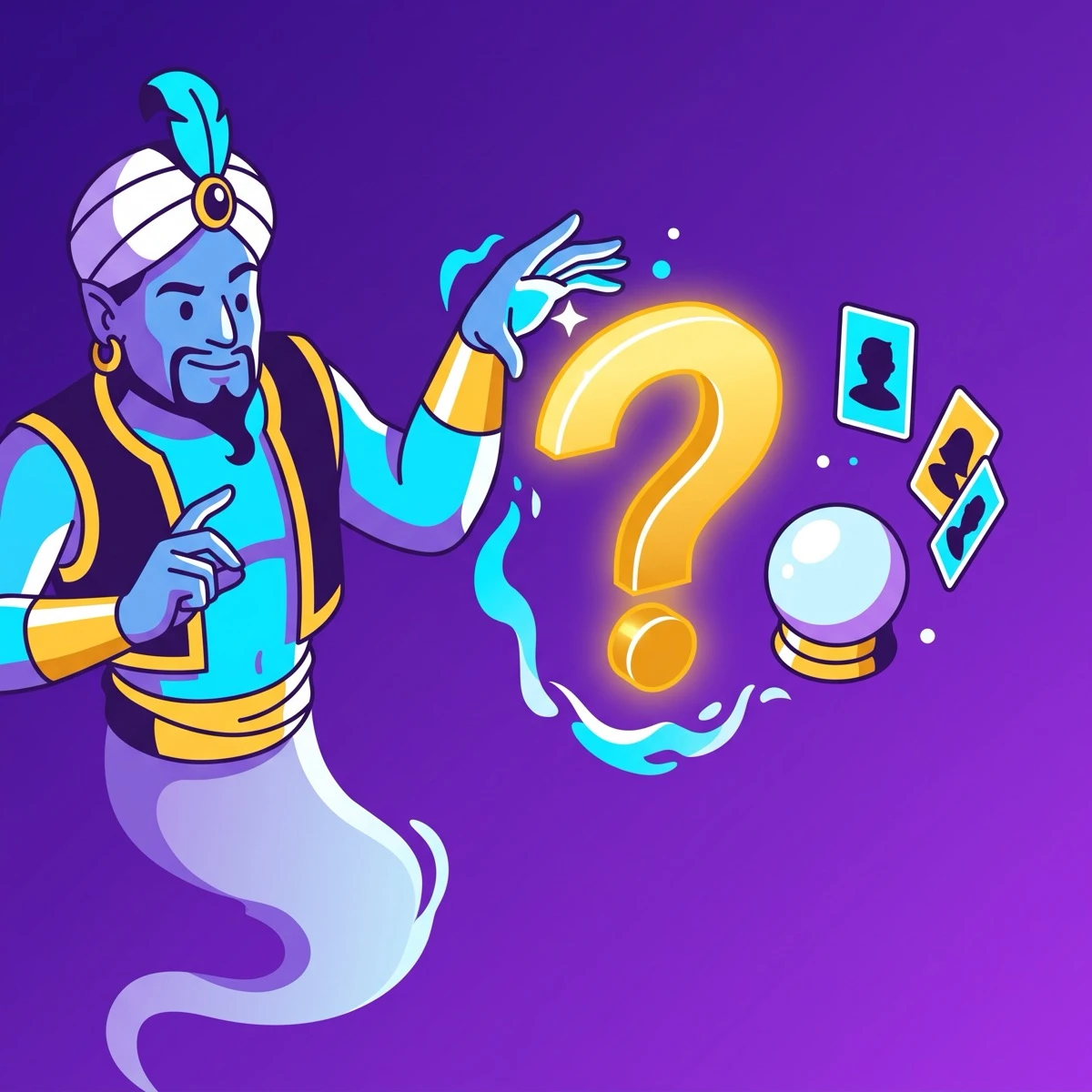
What Counts as a Guessing Game?
A guessing game is any game where you've incomplete information and must arrive at a specific answer through a series of attempts, with feedback between attempts.
That definition matters because it separates guessing games from pure trivia. In trivia, you either know the capital of Bolivia or you don't. In a guessing game, you make an attempt, learn something from the result, and use that information to make a better attempt.
The feedback loop is the whole product. Three components define it:
- The hidden answer — a word, country, film, person, number, or category
- The guess mechanic — how many attempts you get and what form they take
- The feedback signal — what the game tells you after each attempt
Change any one of those and you get a different game. That's why there are hundreds of variations built on what looks like the same idea.
The Core Feedback Types
Sorting games by feedback type is the single most useful thing a beginner can learn. Once I started doing it, I stopped reading tutorials entirely — thirty seconds looking at what the game returns after a wrong guess tells you what it wants from you.
Positional Feedback
The most familiar type. You guess a five-letter word, and the game colours each letter: right letter in the right spot, right letter in the wrong spot, or not in the word at all.
This is deduction with a grid. Every guess eliminates possibilities, and skilled players deliberately "waste" early guesses on letter-heavy words to gather maximum information rather than trying to win immediately.
Distance Feedback
Instead of telling you which parts are right, the game tells you how close you are. Geography games do this well: guess a country, and you're told it's 2,400 miles away and to the northeast.
Distance feedback rewards a completely different skill — spatial reasoning and systematic triangulation. Your first guess is almost never meant to be correct. It's a survey marker.
Semantic Feedback
The clever cousin. Some word games tell you how conceptually similar your guess is to the answer, using a similarity score. Guess "ocean" and you might learn you're 42% close to a word that turns out to be "tide."
These games can be brutal because there's no alphabet to work through. You're navigating meaning itself, and the path from "warm" to "correct" is often counterintuitive.
Twenty Questions Feedback
The classic parlour format, digitised. You think of something; the game asks yes/no questions until it identifies your subject.
The best-known example is Akinator, which asks a sequence of narrowing questions to guess the character or person you've in mind. It's a neat demonstration of how few well-chosen questions are needed to isolate one answer from millions — across the rounds I've played, it has landed inside twenty-five questions almost every time, which is the company's own claim and worth treating as a claim rather than a measurement.
Progressive Reveal
The game shows you a small piece of something and adds more with each failed guess. A zoomed-in photo that widens. A song intro that extends by one second. A film plot summary that gains a sentence.
Scoring here usually rewards early correct answers, which creates real tension: guess now with thin evidence, or wait for more information and score less?
Main Categories Worth Knowing
Word and Language Games
The largest category by a wide margin. Wordle is the reference point; Quordle runs four grids at once, Semantle drops the letter grid entirely, and Connections asks you to sort sixteen words into four themed sets. Same loop, four very different failure modes.
Why they work: Language games have a huge answer space but tight rules, so difficulty scales naturally. They also reward vocabulary without requiring obscure knowledge.
Good for: Daily habit builders, commuters, people who like a five-minute puzzle with a clean finish.
Geography Games
Guess the country from its outline, from a street-level photo, from a flag fragment, or from proximity hints. Some ask you to identify a location from a random photograph and score you on how close your pin lands.
Why they work: Geography has a fixed, verifiable answer set — roughly two hundred countries — which makes the deduction space manageable while still feeling vast.
Good for: Visual thinkers, map enthusiasts, anyone who wants to genuinely learn something as a side effect.
Media and Pop Culture Games
Guess the film from four frames. Guess the song from its opening notes. Guess the actor from a pixelated image. Guess the album from its cover with the text removed.
Why they work: Recognition memory is fast and satisfying. These games feel easier than they are, which keeps people playing.
Good for: Groups, casual play, and testing whether your friend actually watched the film they claim to love.
Number and Logic Games
Higher-or-lower number hunts, mathematical equation puzzles, and deduction grids where you eliminate suspects, weapons, and locations from a set of logical clues.
Why they work: Pure logic, no cultural knowledge required. Fair to everyone regardless of background.
Good for: People who found the word games too language-dependent, and anyone who enjoys a systematic approach.
Social and Multiplayer Guessing
Games where you're guessing what other people answered, not an objective fact. One popular format asks you to predict the most common survey response to a question. Another has friends answering questions about each other.
Why they work: The answer is a human distribution rather than a fact, so the skill is empathy and social intuition instead of knowledge.
Good for: Video calls, parties, remote team icebreakers.
Drawing and Description Games
One player draws or describes; others guess. The interesting design constraint is time pressure combined with imperfect communication — the fun comes from the gap between what one person means and what everyone else understands.
Good for: Mixed-age groups, larger gatherings, low-stakes fun.
The Daily Puzzle Model and Why it Took Over
Most of the well-known guessing games share one structural choice: everyone gets the same puzzle, once per day.
This is a deliberate design decision, and it does several things at once:
- It creates a shared conversation. If we all solved the same puzzle, we can compare notes without spoiling anything.
- It prevents burnout. You can't binge, so the game stays a pleasant ritual rather than a compulsion.
- It makes scores comparable. Same puzzle, same difficulty, honest bragging rights.
- It builds habit through scarcity. A finite daily task feels completable. An infinite feed doesn't.
The trade-off is obvious: if you want to play for an hour, one daily puzzle won't cover it. That's why many players assemble a personal rotation of six or eight different daily games and work through them in sequence.
There's also an unlimited or "practice" mode in many games, which removes the scarcity but also removes the social element. Both models are valid — they just serve different moods.
How to Actually Get Better
Guessing games look like luck. They mostly aren't. Here are the principles that transfer across almost every format.
Optimise for Information, Not Correctness
Your early guesses should be designed to eliminate the largest number of possibilities, even if they've almost no chance of being right.
In a word game, that means starting with a guess containing common letters and varied vowels. In a geography game, it means picking a country in the middle of a continent rather than an island. In a distance-based game, it means your first two guesses should be far apart so you can triangulate.
Beginners try to win on guess one. Experienced players try to learn on guess one.
Track What You've Ruled Out
Write it down if the game doesn't do it for you. Most failed attempts come from re-guessing something already eliminated or forgetting a constraint from three guesses back.
This is especially true in logic-deduction games, where the entire challenge is bookkeeping.
Learn the Answer Space
Every guessing game draws from a pool. Word games usually use common vocabulary rather than obscure terms. Geography games favour recognisable nations. Film games lean towards well-known releases.
Knowing the boundaries of the pool is a legitimate skill. If a five-letter word game has never used a plural ending in S, that's information.
Accept the Loss and Move On
The daily model means you'll fail sometimes. A single miss tells you nothing about your ability — the variance in these games is high, and some answers are simply unfair.
Track your average over thirty days if you care about performance. One day is noise.
Choosing Good Games: What to Look For
Not all guessing games are well made. A few practical markers of quality:
- Clear rules stated upfront. If you can't tell how many guesses you've or what the feedback means, the design is poor.
- Fair answer selection. Answers should come from a reasonable pool. If you lose because the word was a regional dialect term for a farm implement, the game wasted your time.
- No mandatory account. The best browser-based guessing games let you play immediately. Progress tracking is a bonus, not a gate.
- Works on mobile. Most of these games are played on phones. If the grid doesn't fit the screen, that's a tell.
- Light on interruption. Some ad support is normal and keeps free games running. Ads that block the puzzle itself are a different matter.
Signs to be cautious about:
- Requests for personal information beyond an email
- Any prompt for payment details for something advertised as free
- Aggressive notification permissions before you've played a round
- Games that require downloading software to play something that should run in a browser
The overwhelming majority of guessing games are simple, safe browser pages. Just apply the same judgement you'd use on any unfamiliar site.
The Genuine Cognitive Benefits
This isn't a wellness pitch, but the mechanics do map onto real cognitive processes.
Hypothesis testing. You form a theory, test it, and revise based on evidence. That's the scientific method compressed into ninety seconds.
Working memory. Holding several constraints in mind simultaneously while evaluating a new option is a measurable skill, and these games exercise it directly.
Constraint satisfaction. Narrowing a large possibility space using partial information is the same underlying task as debugging code, diagnosing a fault, or planning a route.
Pattern recognition. Especially in visual and geography games, repeated exposure builds genuine recall. People who play map games regularly do learn the shapes of countries.
Tolerance for uncertainty. You act on incomplete information and accept that you might be wrong. That's a useful habit well beyond games.
The evidence on puzzle games and long-term cognitive health is thinner than the marketing implies: trials generally show improvement on the trained task and little transfer beyond it. Treat these games as enjoyable exercise rather than medicine, and you'll be positioned correctly.
Building a Rotation That Suits You
A practical approach for someone starting out:
- Pick one word game. It'll be your anchor habit — quick, daily, low friction.
- Add one visual game. Geography or film. It uses a different part of your brain and prevents fatigue.
- Add one logic game. Something with pure deduction, no cultural knowledge needed.
- Keep one social game in reserve. For calls, parties, and moments when you want company rather than solitude.
- Cap the list. Four to six games is a pleasant ritual. Fifteen is a chore with a streak counter attached.
Rotate anything that stops being fun. There's no obligation to a streak.
Common Beginner Mistakes
- Guessing the answer too early. Wasting information-gathering turns on long-shot attempts.
- Ignoring negative information. Knowing a letter isn't present is as valuable as knowing one is.
- Playing tired. These games depend on working memory, which degrades sharply with fatigue.
- Chasing streaks over enjoyment. The streak is a scoreboard, not the point.
- Skipping the tutorial. Thirty seconds of reading rules prevents ten minutes of confusion.
Where the Format Goes from Here
The design space is far from exhausted. Guessing games work because the underlying loop — guess, learn, refine — is a fundamental human satisfaction, and it can be wrapped around almost any subject.
Expect continued expansion into niche knowledge domains, more sophisticated hint systems, and better multiplayer implementations. The core mechanics described in this guide will remain the foundation regardless of what gets built on top of them.
Learn the feedback types, understand that early guesses are for information rather than victory, and you'll be able to pick up any guessing game you encounter and play it competently within a minute.
That's the entire skill. The rest is just picking subjects you enjoy.